BiTURF: Quantifying uncertainty to enhance strategic decision-making. Food Quality and Preference
• Have you ever faced decisions such as:
• You need to decide which flavor variants of food items to actively market from a broad set of options.
• Your company asked you to support the decision to eliminate a product from a line.
• You are working for a retailer, and your task is to decide which product variants to list in a limited amount of shelf space.
• As a manufacturer of personal care products, you need to decide which health benefits to include in your skin care products to attract many consumers.
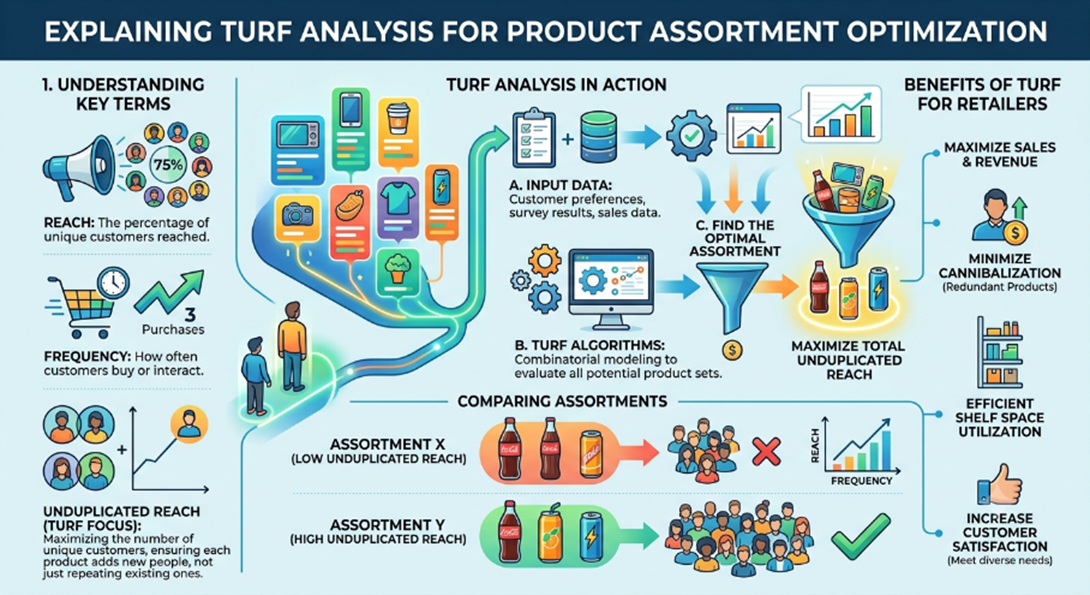
In these and similar managerial challenges, Total Unduplicated Reach and Frequency Analysis (TURF) has likely already crossed your path. Broadly speaking, the method helps companies select a set of actions to implement from a large set of competing alternatives. It does so by systematically integrating consumer preferences into the decision-making process. A drawback of this otherwise versatile method is that uncertainty in TURF’s results is usually not quantified or accounted for.
In our latest paper, titled BiTURF (Bayesian input TURF), our team members Joshua Schramm, Felix Lang, and Marcel Lichters introduce an enhanced TURF methodology that captures uncertainty in the results via Bayesian posterior sampling. This approach not only strengthens the foundation for managerial decision-making but also offers additional advantages, such as enabling direct comparisons of product assortments using Bayesian significance tests.
The paper features clear examples based on data from Maximum Difference Scaling and Check-All-That-Apply questions.
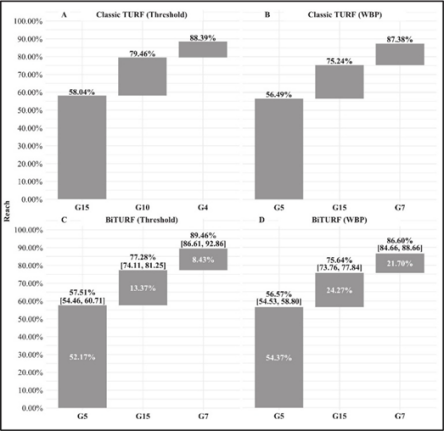
Additionally, we offer a helpful tutorial on how to perform BiTURF using open-source software R/Stan, available at: https://doi.org/10.17605/OSF.IO/FDH24
Schramm, J. B., Lang, F. J., & Lichters, M. (2026). BiTURF: Quantifying uncertainty to enhance strategic decision-making. Food Quality and Preference, 145, Article 106001. https://doi.org/10.1016/j.foodqual.2026.106001
Due to open access, the article is available here for free